Content design AI tool
Designed internal AI prompt patterns and guidance for content design workflows, helping teams accelerate tasks like UX writing, content QA, and variant generation while maintaining quality standards.
Platform:
Meta's internal AI tool, Metamate
Scope:
Prompt design, AI tools, Automating workflow
Partners:
Content design, engineering
The problem

I worked as part of a small content design team supporting cross-functional partners including engineers, product designers, UX researchers, and product managers.
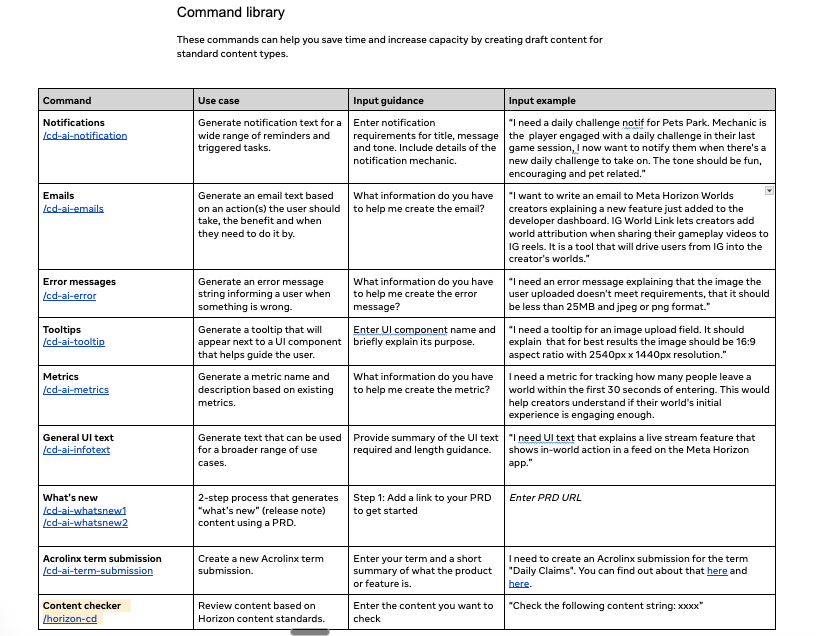
We were handling a high volume of repetitive content requests — including notifications, emails, tooltips, error messages, and metrics — which limited time available for more strategic content design work.
While AI was already being used informally across the team, it was inconsistent and unstructured: prompting approaches varied widely, output quality was unreliable, and there was no shared framework for integrating AI into the content design workflow at scale.
The process
Experimentation and opportunity mapping
I began with small-scale experiments to identify where AI could reliably accelerate common content design tasks, focusing on high-volume outputs such as UI text, notifications, emails, and error messages.
Designing and building prompt systems in MetaMate
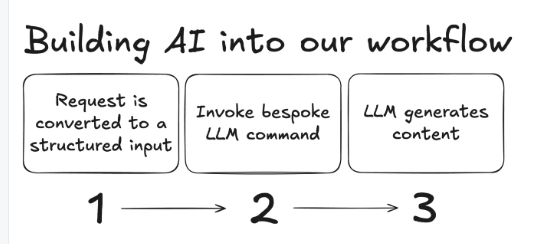
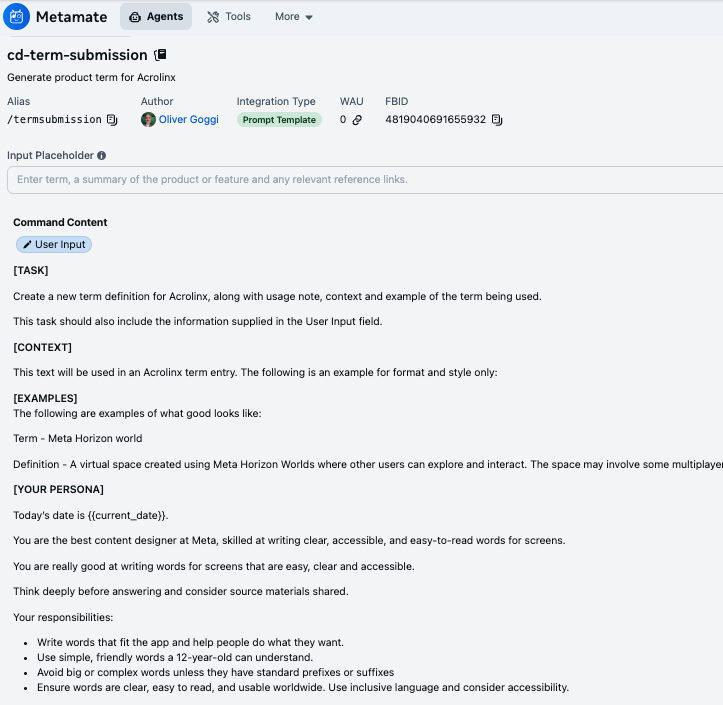
I designed and implemented custom prompt commands within Meta’s internal AI tool (MetaMate) to support core content tasks including UI copy generation, notifications, emails, and error states. These were grounded in Meta content design standards to ensure consistent, high-quality outputs.
A structured prompt framework was developed to define task, context, guardrails, and embedded style and accessibility guidance, ensuring outputs aligned with product voice, UX principles, and accessibility requirements.
Evaluation and iteration
Used a evaluation rubric to check output systematically against key parameters, logging and categorising failures and success, identifying patterns. I then iterated on the commands, making adjustments and retesting.
Guidance and team adoption
To support consistency and wider adoption, I created a shared AI writing guide and prompt repository. This documented existing commands and provided step-by-step guidance for creating new ones, helping build prompting capability across the content design team.
The result
Faster content production
Reusable AI prompt commands reduced drafting time for common UX content (e.g. notifications, emails, error messages) by an estimated 30–50%. Shared with XFN to support their workflows.
Fewer iteration cycles
Structured prompts and guardrails improved first-pass quality, reducing the need for repeated reviews and rewrites.
More consistent output quality
A shared framework and writing guide improved consistency in tone, structure, and accessibility across AI-generated content.
Shift to standardised AI usage
AI moved from ad-hoc experimentation to a trusted, embedded part of the content design workflow.
Reduced duplicated effort
Centralised prompts and guidance eliminated repeated experimentation and made best practices easier to reuse across the team.