Business site redesign and migration
Migrating and consolidating a large, complex content estate across BT's Global and Enterprise websites to create a unified, streamlined digital experience.
Platform:
BT Business website
Scope:
Content strategy, UX writing, IA, Accessibility, SEO
Partners:
Product management, marketing, UX design, SEO, and content operations teams
The problem

BT was merging its Global and Enterprise websites to support a unified business model, requiring the migration and consolidation of a large, complex content estate into a single streamlined experience. The goal was to improve product discoverability, simplify information architecture, and enhance overall search performance.
The existing content was fragmented across multiple domains, leading to duplication, inconsistency, and unclear user journeys. The product catalogue was extensive and uneven in quality, with varying levels of relevance and structure, making migration and consolidation complex.
The work was constrained by the need to avoid a full rewrite, meaning improvements had to be targeted and efficient while still delivering meaningful structural change. It also required balancing input from multiple stakeholders across product, marketing, and content teams, while maintaining SEO performance throughout the migration.
The process
Content strategy and migration approach
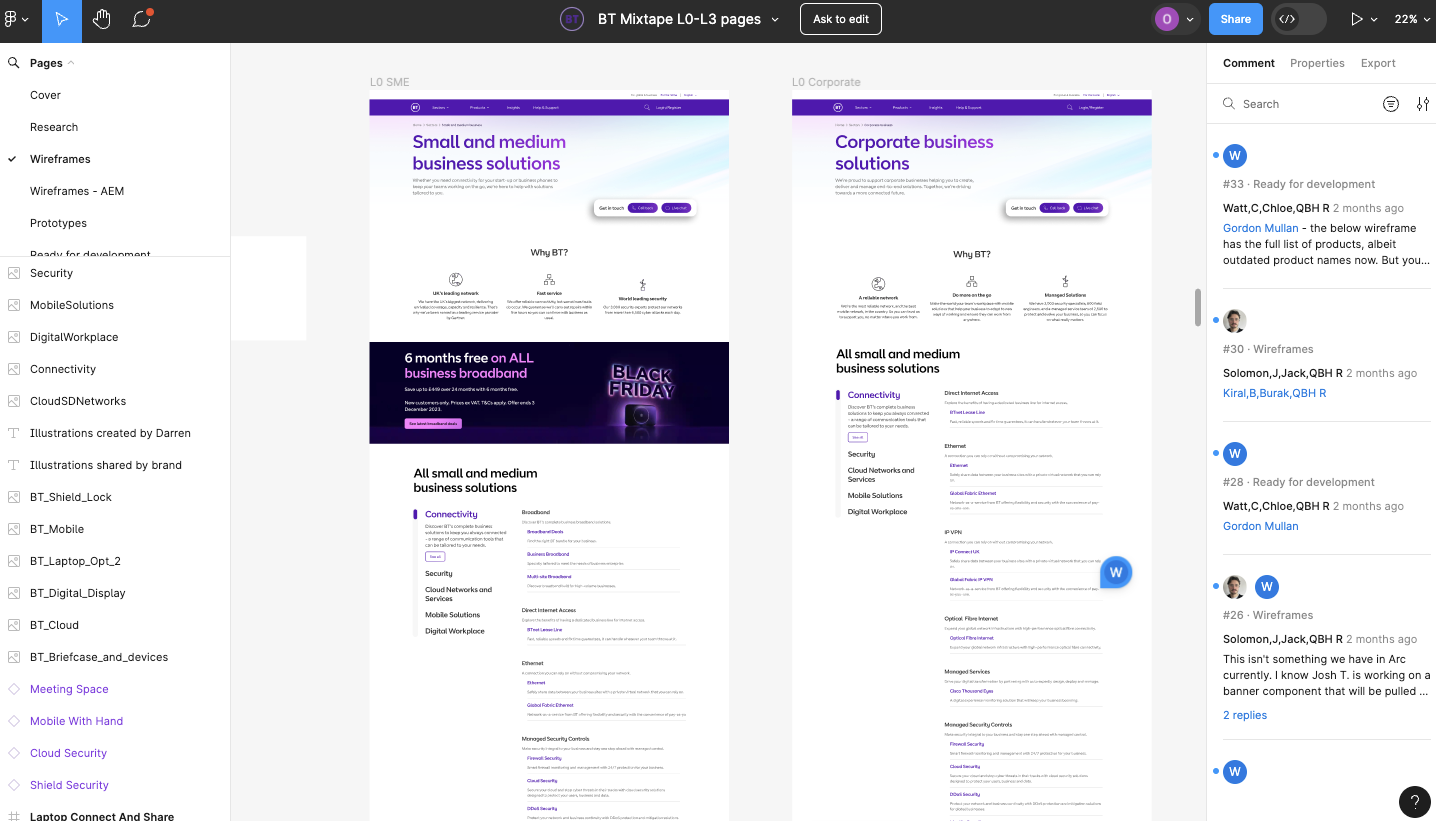
I worked across content strategy and execution to support the migration and rationalisation of BT’s product catalogue. Given the scale of the estate, I used a batched approach, grouping content by readiness to enable structured review, prioritisation, and phased migration.
Information architecture and templates
I helped define a new content hierarchy and page structure, informed by performance data, SEO insights, and user needs. This work fed into standardised product page templates, improving consistency and making content easier to navigate and maintain at scale.
Stakeholder collaboration and content creation
Working closely with product and marketing teams, I gathered inputs such as target audiences, business goals, and product USPs. These were translated into content briefs, which I used to create or refine product pages. I applied content design principles throughout to improve clarity, structure, usability, and SEO performance, including metadata, page titles, and keyword integration.
Tools, systems, and delivery management
I used Mural and spreadsheets to map content structures and define hierarchy, while Airtable served as a central source of truth for tracking content, workflows, and migration progress across teams.
The result

The project delivered a consolidated and more coherent content experience across BT Business, replacing fragmented journeys with a unified structure. Clear page hierarchies and templates improved consistency and made product information easier to understand and compare.
The batched migration approach enabled the team to manage a large-scale content transformation efficiently within tight timelines. Content was better aligned to user needs and business priorities, while SEO considerations were embedded throughout, helping to maintain and strengthen search performance.
The work was positively received by senior stakeholders, who highlighted the improved clarity, structure, and scalability of the approach, as well as the effectiveness of the cross-functional coordination in delivering at pace.
Overall, the project established a scalable content system and governance model that supports ongoing content management and future growth.